Arabic Phrases for Beginners: 10 Easy Ways to Speak with Joy
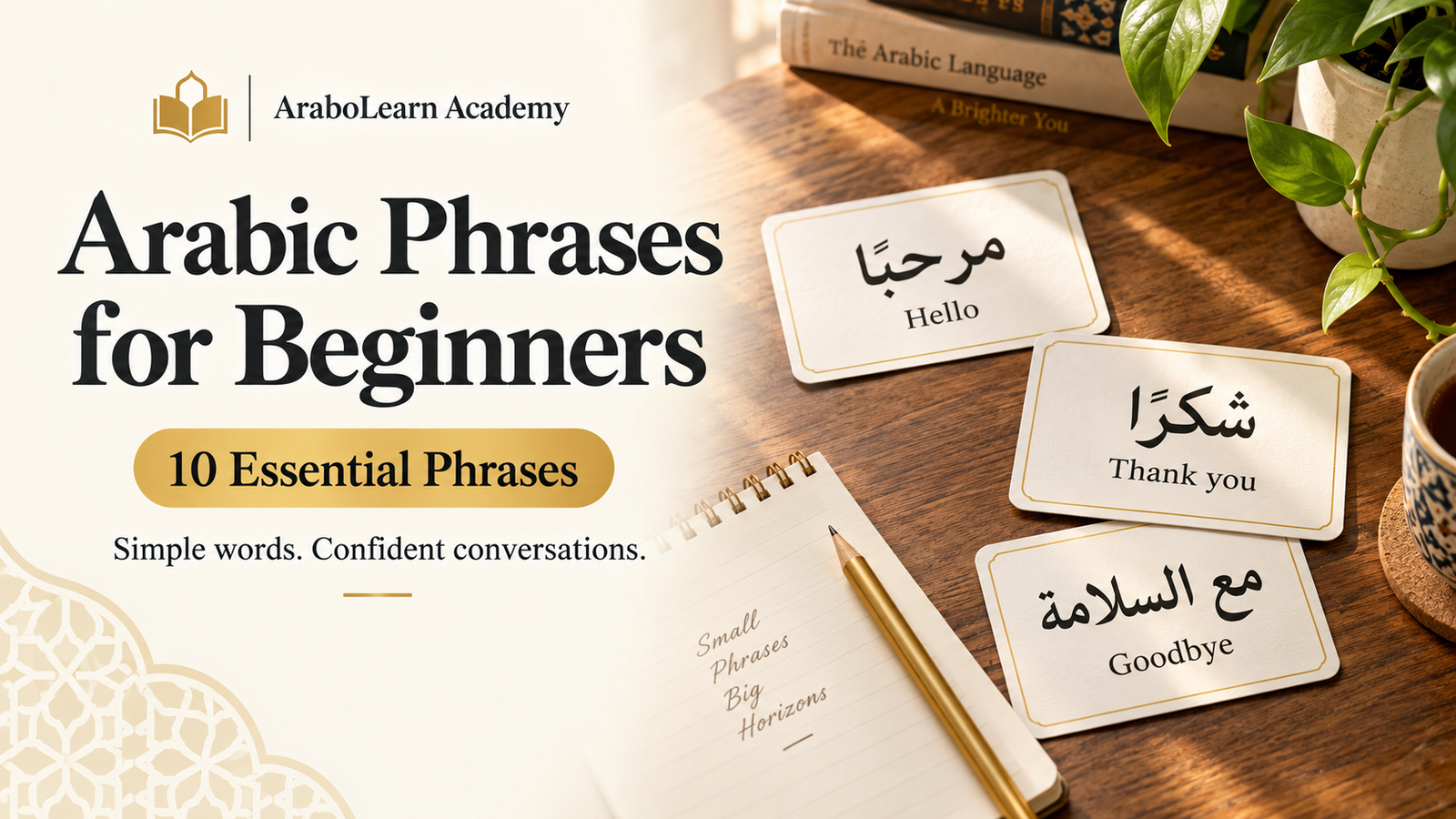
Arabic phrases for beginners can make everyday life in the UAE feel a little more familiar. A simple greeting, a polite thank-you, or a short question gives you a practical way to start using the language.
You do not need to memorise hundreds of words before speaking. Start with a few expressions you understand, practise them aloud, and look for comfortable opportunities to use them.
This guide introduces ten useful phrases with Arabic spelling, simple pronunciation guides, and examples. Whether you are learning for work, travel, family, or daily life, these expressions provide a manageable starting point.
Why Start with Arabic Phrases for Beginners?
Learning complete expressions helps you connect vocabulary with a real purpose. Instead of memorising a word in isolation, you learn something you can say when entering a shop, meeting someone, or asking for help.
Short phrases also give you a chance to practise Arabic sounds without building every sentence from scratch.
The expressions below include widely understood greetings and standard Arabic forms. Everyday Emirati and Gulf Arabic may use different wording or pronunciation. Treat these examples as a foundation rather than a complete guide to the local dialect.
The English spellings are approximate pronunciation aids. Listening to a teacher or clear audio example will help you hear sounds that English letters cannot represent precisely.
10 Arabic Phrases for Beginners to Practise
1. Marhaba — Hello
Arabic: مرحبًا
Pronunciation: mar-ha-ba
Meaning: Hello.
Marhaba is a useful greeting to learn first. You can practise it when beginning a friendly conversation or greeting someone you know.
Start by saying the word slowly, then repeat it naturally. A simple greeting is enough for your first speaking goal; you do not need to follow it with a long conversation.
2. As-salamu alaykum — Peace Be Upon You
Arabic: السلام عليكم
Pronunciation: as-sa-laa-mu a-lay-kum
Meaning: Peace be upon you.
This is a common Arabic greeting. A customary reply is wa alaykum as-salam, meaning “and peace be upon you.”
Practise the greeting and reply together with a learning partner. Taking turns helps you recognise the expression when you hear it as well as remember how to say it.
3. Sabah al-khayr — Good Morning
Arabic: صباح الخير
Pronunciation: sa-baah al-khayr
Meaning: Good morning.
Use this greeting when meeting someone in the morning. A common reply is sabah an-noor, an expression referring to a morning of light.
Try linking it to an existing routine, such as greeting a colleague or practising with your family before the day begins.
4. Shukran — Thank You
Arabic: شكرًا
Pronunciation: shuk-ran
Meaning: Thank you.
Shukran is short and easy to practise in everyday situations. Use it when someone helps you, answers a question, or gives you something.
Learning polite expressions early gives your vocabulary an immediate purpose. You can practise this word on its own before combining it with longer sentences.
5. Min Fadlak / Min Fadlik — Please
Arabic: من فضلك
Pronunciation: min fad-lak / min fad-lik
Meaning: Please.
In standard Arabic, use min fadlak when addressing a man and min fadlik when addressing a woman.
The everyday written form often looks the same because short vowel marks are usually omitted. Practise hearing the difference between the two endings, then use the appropriate form in a simple request.
6. Na‘am / La — Yes / No
Arabic: نعم / لا
Pronunciation: na-am / laa
Meaning: Yes / No.
These two words help you respond to simple questions. The middle sound in na‘am is the Arabic letter ع, which does not have an exact English equivalent.
Do not worry about perfect pronunciation immediately. Listen carefully, repeat slowly, and ask for feedback as you continue learning.
7. Ismi… — My Name Is…
Arabic: اسمي…
Pronunciation: is-mee
Meaning: My name is…
Add your name after ismi to introduce yourself.
For example, “Marhaba, ismi Sara” means “Hello, my name is Sara.”
This is a useful first combination because it connects two expressions you already know. Practise introducing yourself without reading from the page.
8. Kayfa Haluk? — How Are You?
Arabic: كيف حالك؟
Pronunciation: kay-fa haa-luk
Meaning: How are you?
This is a standard Arabic question. When addressing a woman, the fully pronounced standard form is kayfa haluki.
One possible response is ana bikhayr, shukran, meaning “I am well, thank you.”
You will hear other versions in everyday dialects. Learning the standard expression gives you a starting point for recognising those variations later.
9. La Afham — I Do Not Understand
Arabic: لا أفهم
Pronunciation: laa af-ham
Meaning: I do not understand.
This expression helps you communicate honestly when a conversation becomes difficult.
You do not need to pretend you understood every word. Letting the other person know gives them an opportunity to repeat, simplify, or explain.
Practise this phrase alongside greetings so it is easier to remember when you need it.
10. Ma‘a as-salama — Goodbye
Arabic: مع السلامة
Pronunciation: ma-a as-sa-laa-ma
Meaning: Goodbye.
Use this expression when ending a conversation or leaving.
Practise a short exchange from beginning to end: greet someone, introduce yourself, thank them, and say goodbye. Connecting phrases into an exchange helps you remember when each one belongs.
How to Practise Arabic Phrases for Beginners
Choose three expressions for your first practice session. Say each one slowly, recall its meaning, and imagine a situation in which you could use it.
Try this ten-minute routine:
- Listen for two minutes: Use a clear recording or a teacher’s example.
- Repeat for three minutes: Focus on one expression at a time.
- Recall for two minutes: Cover the translation and remember the meaning.
- Practise for three minutes: Use the expressions in a short exchange.
Return to familiar phrases before adding new ones. You can also record yourself and compare your pronunciation with the example you are following.
For additional context, the UAE’s official visitor guide includes a short list of common Arabic words and greetings.
Common Mistakes to Avoid
Learning too many expressions at once: A short list you can recall is more useful for practice than a long list you rarely review.
Relying only on English spellings: Pronunciation guides are helpful at the beginning, but Arabic letters and audio will support your progress.
Expecting every speaker to use identical wording: Formal Arabic and everyday dialects differ. Ask your teacher which expressions suit your learning goals.
Waiting until you feel perfect: Begin with a greeting or thank-you in a comfortable situation. Small speaking attempts give you experience to build on.
Take the Next Step with AraboLearn Academy
These Arabic phrases for beginners give you a practical starting point. Your next step is to connect useful expressions with listening, letter recognition, and simple sentence building.
Explore AraboLearn’s Arabic learning resources for materials to support your practice.
For a more structured learning path, browse AraboLearn Academy’s courses and choose a starting point that matches your goals.
Start with a few expressions today, practise them regularly, and let your confidence grow through use.