
Is Your Child New to Arabic? Start with the Right Foundation in 7 Days
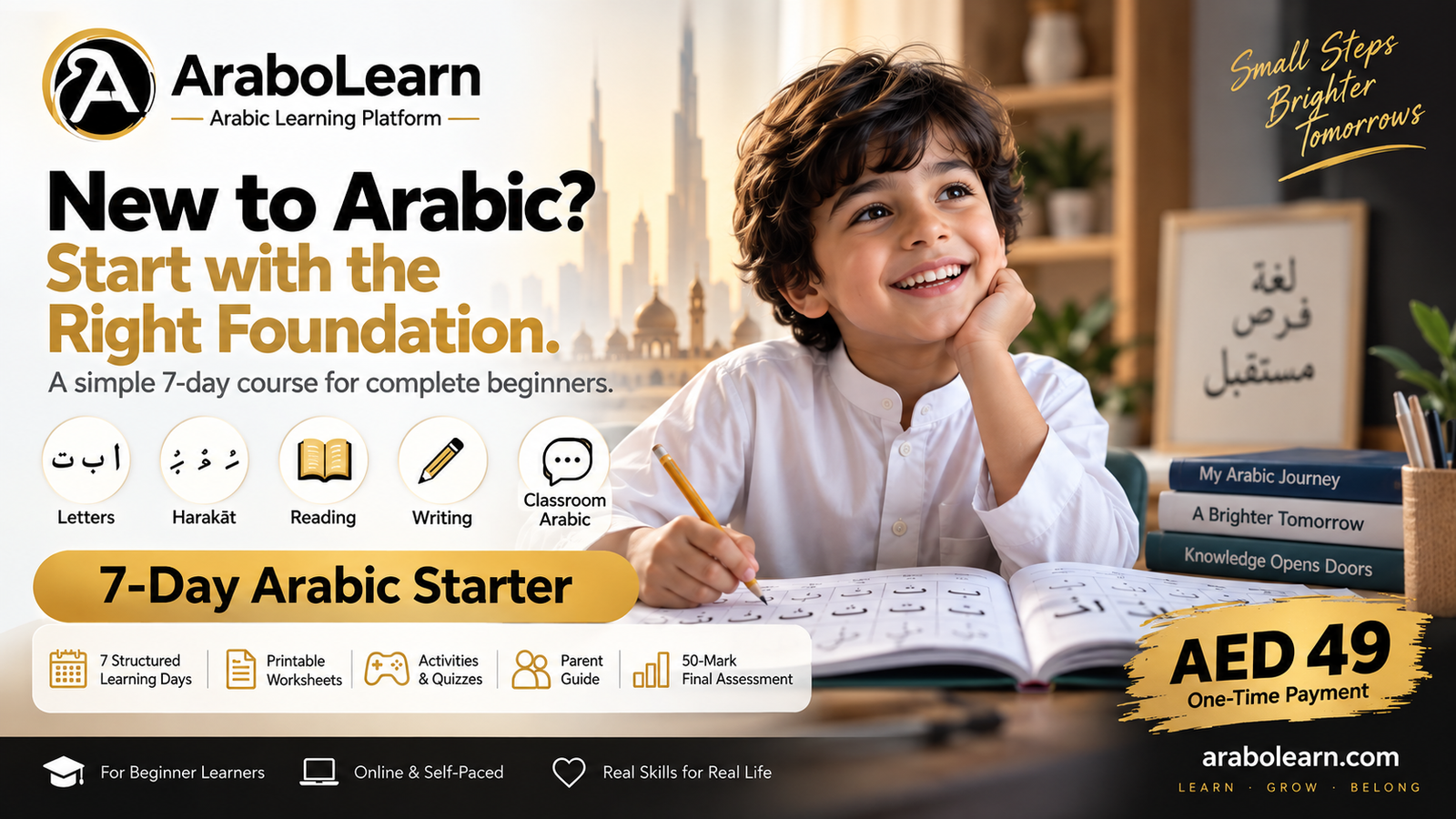
Arabic for Beginners in UAE can feel challenging, especially for children who are completely new to the language. When a child enters a UAE school without a strong Arabic foundation, unfamiliar letters, sounds, reading and classroom instructions can quickly become overwhelming.
They may open their Arabic textbook and see unfamiliar letters, different sounds, and words written from right to left. Even simple classroom instructions can initially feel confusing.
“Where should my child actually start?”
The answer is not to rush into difficult grammar or large vocabulary lists. A beginner needs a clear foundation first.
That is why AraboLearn created the 7-Day Arabic Starter—a simple and structured introduction designed to help complete beginners take their first practical steps in Arabic.
Why Can Arabic Feel Difficult for a Beginner?
Imagine a child who has never studied Arabic before. At school, the teacher may write كِتَابٌ or say اِفْتَحِ الْكِتَابَ.
For a child who already understands Arabic letters and sounds, these may be manageable. But for a complete beginner, there are several things to process at once.
The child first needs to understand that Arabic is written from right to left. They need to recognize letters, distinguish similar-looking letters, understand basic vowel marks, connect letters with sounds, and gradually begin reading words.
Start small → Understand the basics → Practise regularly → Build confidence.
What Should a Child Learn First in Arabic?
A strong beginning does not require hundreds of words or complicated grammar rules. A complete beginner should focus first on a few essential skills.
1. Recognizing Arabic Letters
Arabic has 28 letters, and recognizing them is one of the first steps toward reading.
ب ت ث
Children also need to notice important differences between similar letters, particularly their dots.
2. Understanding Basic Harakāt
Once children become familiar with letters, they can begin connecting them with short vowel sounds.
بَ بُ بِ
- َ Fatha
- ُ Damma
- ِ Kasra
This is an important bridge between recognizing a letter and actually beginning to read Arabic.
3. Reading Simple Arabic
After learning letters and basic sounds, children can begin reading simple combinations and beginner words.
- أَبٌ — Father
- أُمٌّ — Mother
- بَابٌ — Door
- بَيْتٌ — House
- كِتَابٌ — Book
- قَلَمٌ — Pen
4. Practising Arabic Writing
Arabic should not only be watched or memorized. Children need opportunities to trace, copy and write what they are learning.
Simple worksheet activities can reinforce letter recognition while helping children become comfortable with Arabic writing.
5. Learning Useful Classroom Arabic
For children studying Arabic at school, practical classroom language can be especially useful.
- اِقْرَأْ — Read
- اُكْتُبْ — Write
- اِسْمَعْ — Listen
- اِجْلِسْ — Sit down
- قِفْ — Stand up
- اِفْتَحِ الْكِتَابَ — Open the book
Introducing the AraboLearn 7-Day Arabic Starter
The AraboLearn 7-Day Arabic Starter is an online, self-paced course designed to provide Arabic for Beginners in UAE with a simple and structured starting point, especially for children beginning Arabic at school.
It is particularly suitable for:
- Children who have never studied Arabic before
- Students who are new to the UAE and beginning Arabic at school
- Children who need to strengthen their basic Arabic foundation
- Parents looking for a clear starting point for their child’s Arabic learning
The goal is not to teach the entire Arabic language in seven days. The goal is to give the child a clear and encouraging first foundation from which further Arabic learning can grow.
What Will Your Child Learn in 7 Days?
Day 1 — Welcome to Arabic
ا — ب — ت — ث
Children are introduced to Arabic writing, letter recognition, pronunciation, tracing and dots.
Day 2 — Discover Letter Families
ج ح خ — د ذ — ر ز — س ش — ص ض
Children explore groups of letters with similar shapes and learn to notice their differences.
Day 3 — Complete the Arabic Alphabet
ط ظ ع غ ف ق ك ل م ن هـ و ي
By this stage, children have been introduced to all 28 Arabic letters.
Day 4 — Harakāt and First Reading
Children learn Fatha, Damma and Kasra, connect letters with sounds and begin simple reading practice.
Day 5 — Read Your First Arabic Words
أَبٌ — أُمٌّ — بَابٌ — بَيْتٌ — كِتَابٌ — قَلَمٌ — مَدْرَسَةٌ
Children practise recognizing, reading, tracing and matching beginner Arabic words.
Day 6 — Arabic at School
Children are introduced to useful classroom expressions such as اِقْرَأْ, اُكْتُبْ, اِسْمَعْ, اِجْلِسْ and قِفْ.
Day 7 — Arabic School Challenge
The final day brings everything together: letters, harakāt, reading, words, writing and classroom Arabic.
Children review their learning and complete the final assessment.
Ready to Give Your Child the Right Start?
Begin with a structured 7-day introduction to Arabic designed for complete beginners.
AED 49 — One-Time Payment
What’s Included?
- ✓ 7 structured learning days
- ✓ Beginner-friendly lessons
- ✓ Printable worksheets
- ✓ Writing and tracing practice
- ✓ Activities and quizzes
- ✓ Parent guide
- ✓ Progress practice
- ✓ 50-mark final assessment
The recommended learning time is approximately 15–20 minutes per day, making the program easier to fit around school and family routines.
A Simple Learning Routine
Watch → Repeat → Practise → Write → Check → Review
The purpose is to move children from simply seeing Arabic to actively using what they have learned.
Parents Can Help Too
Parents do not need to be Arabic teachers to encourage their children. Even a few minutes of simple review can be valuable.
Try This 5-Minute Home Routine
- 1 minute: Review today’s letters or sounds.
- 2 minutes: Ask your child to recognize or read them.
- 2 minutes: Review the worksheet together.
How Do We Check the Child’s Progress?
At the end of the seven days, learners can complete a 50-mark final assessment.
| Area | Marks |
|---|---|
| Arabic Letters | 10 |
| Harakāt | 10 |
| Reading | 10 |
| Vocabulary | 10 |
| Classroom Arabic | 10 |
| Total | 50 |
Can a Child Learn Arabic in 7 Days?
A child cannot realistically master an entire language in seven days—and that is not what this course promises.
The 7-Day Arabic Starter is a starting point.
The goal is to build familiarity with Arabic letters, basic harakāt, selected words, simple reading activities, writing practice and useful classroom expressions.
Think of it as laying the first bricks of a much bigger foundation.
What Comes After the 7-Day Starter?
7-Day Arabic Starter
↓
Arabic Foundation Program
↓
School Arabic Support
↓
Grade-Specific Arabic Learning
Give Your Child a Clear Place to Start
When a child is new to Arabic, the most important thing is not to teach everything immediately. It is to start correctly.
One Letter. One Sound. One Word.
One Small Achievement at a Time.
The AraboLearn 7-Day Arabic Starter is designed to make those first steps structured, practical and encouraging.