
Arabic Reading Practice for Kids: 10 Easy Activities at Home
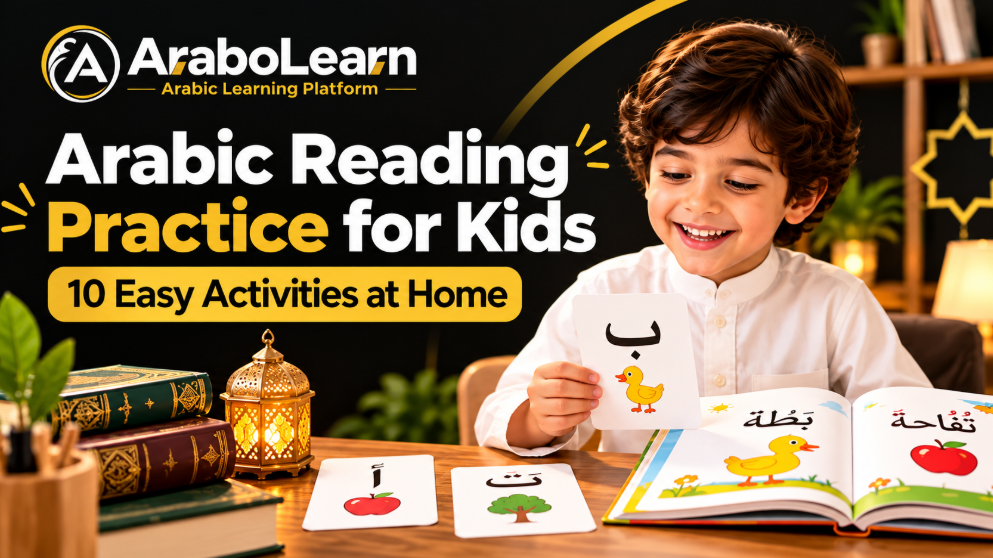
Learning to read Arabic can feel difficult for children at the beginning. They may recognize individual letters but struggle when those letters appear inside words. Some children know the alphabet but become confused by Harakāt, joined letters, similar-looking characters, or unfamiliar vocabulary.
The good news is that Arabic reading practice for kids does not need to mean long lessons or complicated worksheets.
With a few simple activities, parents can help children practise Arabic for just 10–15 minutes a day while building stronger reading habits.
The goal is not to make children read quickly. The first goal is to help them recognise letters accurately, connect letters with sounds, read simple words, understand basic vocabulary, and gradually become more independent.
Here are 10 easy activities you can use at home.
1. Play an Arabic Letter Detective Game
Start with letters that look similar.
For example:
ب – ت – ث
Ask your child:
“Which letter has one dot below?”
“Which letter has two dots above?”
“Which one has three dots?”
Then try another family:
ج – ح – خ
Ask:
“Which letter has no dot?”
“Which letter has a dot below?”
“Which one has a dot above?”
This simple game helps children notice small visual differences.
That is important because many early Arabic reading mistakes happen when children confuse letters with similar shapes.
For younger children, make it fun. Call them Arabic Letter Detectives and ask them to find the correct letter.
2. Practise One Letter With Three Harakāt
Once a child recognises a letter, practise its different short vowel sounds.
For example:
بَ – بُ – بِ
Then:
تَ – تُ – تِ
And:
مَ – مُ – مِ
Do not rush through many letters.
Choose only two or three letters in one session.
Point to each one and ask the child to read the sound.
This kind of Arabic reading practice for kids helps them understand that the same Arabic letter can produce different sounds depending on the Harakah.
You can also reverse the activity.
Say a sound such as بِ, and ask your child to point to the correct form.
3. Use Arabic Flashcards Around the House
Children often learn better when Arabic is connected to real objects.
Create simple cards for familiar items and place them around the home.
You might use words such as:
بَابٌ — door
كِتَابٌ — book
قَلَمٌ — pen
كُرْسِيٌّ — chair
Each time your child sees the object, encourage them to read the Arabic word.
Do not introduce too many words at once.
Start with three or four.
Once those words become familiar, replace them with new ones.
This makes Arabic reading part of everyday life rather than something that happens only during homework time.
4. Read Three Words Every Day
A child does not need to read an entire page every day.
Sometimes three carefully chosen words are enough.
Choose three words that are appropriate for your child’s level.
For example:
أَبٌ
أُمٌّ
بَيْتٌ
Read the first word together.
Ask your child to try the second independently.
Help with the third if necessary.
Then return to all three at the end.
Tomorrow, review the same words before introducing new ones.
Regular repetition is one of the simplest ways to strengthen Arabic reading practice for kids.
5. Match Arabic Words With Pictures
Picture matching is useful because children are learning reading and meaning at the same time.
Prepare pictures of familiar things such as:
a house, book, school, apple, cat, car, father, or mother.
Then prepare corresponding Arabic word cards.
For example:
بَيْتٌ
كِتَابٌ
مَدْرَسَةٌ
تُفَّاحَةٌ
Ask the child to read the word and place it beside the correct picture.
If they cannot read it independently, read it together first.
Later, mix the cards again and repeat the activity.
This prevents reading practice from becoming simple memorisation without understanding.
6. Try the “Find the Letter” Challenge
Take a simple Arabic page from a children’s book, worksheet, or school material.
Choose one target letter.
For example:
ب
Ask your child to circle every ب they can find.
Next time, choose:
ت
or:
م
As the child improves, make the activity more challenging.
Ask them to find a letter at the beginning of words, middle of words, or end of words.
This teaches children that Arabic letters can appear in different forms depending on their position.
It is an especially useful activity for beginners who recognise isolated letters but struggle when letters are joined together.
7. Read and Repeat
Children need to hear Arabic as well as see it.
Choose a simple word or sentence.
Read it clearly first.
Then ask your child to repeat after you.
For example:
هٰذَا كِتَابٌ.
Read it once naturally.
Read it again slowly.
Then let your child repeat.
Finally, ask the child to try reading it without your help.
This method combines listening, pronunciation, visual recognition, and speaking.
For children who are learning Arabic as an additional language, hearing correct pronunciation regularly can make reading much easier.
8. Build a Sentence One Word at a Time
Sentence building can make Arabic reading practice for kids more interesting once they are comfortable with simple words.
Prepare separate cards such as:
هٰذَا
كِتَابٌ
Ask the child to read each card.
Then put them together:
هٰذَا كِتَابٌ.
You can later try:
هٰذِهِ حَقِيبَةٌ.
Or very simple personal sentences such as:
أَنَا طَالِبٌ.
Breaking a sentence into smaller pieces helps children see how words work together.
It also prepares them gradually for grammar and sentence-building activities.
9. Use a Five-Minute Reading Challenge
Set a timer for only five minutes.
Tell your child:
“Let’s see how much Arabic we can read carefully in five minutes.”
The goal should not be speed.
The goal is focused practice.
During those five minutes, the child could review:
two letters,
three sounds,
three words,
and one short sentence.
A short daily activity is often easier to maintain than a long study session once a week.
Parents can gradually extend the time as the child becomes more comfortable.
Consistency matters much more than forcing a long lesson.
10. Finish With One Successful Task
Always try to end the practice session with something the child can do successfully.
If your child struggled with several new words, finish by asking them to read a letter or word they already know.
For example:
“Before we finish, can you show me ب?”
Or:
“Can you read أُمٌّ one more time?”
This allows the session to end positively.
Instead of focusing only on mistakes, recognise specific progress.
You might say:
“You remembered the Kasra today.”
“You found all the letters correctly.”
“You read that word without help.”
Specific encouragement is more meaningful than simply saying “good job.”
A Simple 10-Minute Arabic Reading Routine
You can combine these activities into one short daily routine:
Minutes 1–2: Review Arabic letters
Minutes 3–4: Practise Harakāt and sounds
Minutes 5–7: Read three simple words
Minutes 8–9: Read one short sentence
Minute 10: Review the most difficult item and finish with something easy
You do not have to use exactly the same routine every day.
Some days can focus more on letters.
Other days can focus on vocabulary, reading, or listening.
The important thing is to keep the learning manageable.
What If My Child Is a Complete Beginner?
If your child has never learned Arabic letters before, starting with full words and sentences may be too difficult.
Begin with a simple introduction to the alphabet, basic sounds, and Harakāt.
At AraboLearn Academy, the 7-Day Arabic Starter Course is designed as an introductory step for learners who are completely new to Arabic.
After developing this initial familiarity, learners can move into the Arabic Foundation Program, which develops Arabic through a more structured journey covering letters, sounds, reading, writing, vocabulary, practical grammar, sentence building, comprehension, listening, and speaking.
Internal link suggestion: Link 7-Day Arabic Starter Course to your Starter Course page.
Internal link suggestion: Link Arabic Foundation Program to your Foundation Program course page.
Supporting Children Who Find Arabic Difficult
Some children need more time than others.
If your child can recognise letters but cannot read words, return to letter sounds and Harakāt.
If they can read words but do not understand them, spend more time developing vocabulary.
If they know words but struggle with sentences, practise very short sentence patterns.
Parents should avoid comparing one child’s progress with another.
Instead, look for improvement in the individual learner.
A child who needed help reading five words last week may be able to read three of them independently this week. That is meaningful progress.
You can also read our guide “7 Proven Ways to Make Arabic for Kids in UAE Easier and More Successful” for broader advice on helping children develop their Arabic skills.
Make Arabic Reading Part of Everyday Life
Arabic should not feel like a subject that exists only inside a textbook.
Look for simple opportunities to use it throughout the day.
Read Arabic signs together.
Notice letters on packaging.
Look for Arabic words while travelling.
Ask children to recognise familiar letters.
Review a word before bedtime.
These small moments add up.
The more frequently children see and hear Arabic, the more familiar the language becomes.
Final Thoughts
Effective Arabic reading practice for kids does not require hours of daily study.
A better approach is short, consistent, level-appropriate practice.
Start with letters.
Connect letters to sounds.
Introduce Harakāt.
Read simple words.
Build useful vocabulary.
Move gradually into sentences.
Most importantly, give children enough time to practise each stage before moving forward.
When learning is structured into small achievable steps, Arabic reading can become much less intimidating and much more enjoyable.
At AraboLearn Academy, we believe strong Arabic skills are built step by step.
Learn. Grow. Belong.